Back in January I had several days in Nagoya, Japan. On one I visited Ghibli Park, which I had been building up in my head for months. This is a piece about that day. It’s partly a field report, partly an argument about why some spaces hold more than others and why the money upstream of a space shapes it more than the people who design it, and partly me trying to figure out why I wanted to photograph a cereal box.
Hope you’re well :)
The theater seats a hundred and some people. The porthole windows along the walls pull everything in close, like being inside a submarine that has agreed to show us a film as it submerges. When the lights go down, the portholes darken from the bottom up. We go under.
Two hands rise from the lower center of the screen as the projector lights up, fingers spread, making shadow puppets. I turn around to see who’s doing this. Nobody is. The projector is mounted ten feet too high for any human to reach. The hands are part of the film. I have been fooled.
The film that is beginning is sixteen minutes. It’s called Hoshi o Katta Hi, “The Day I Bought a Star,” directed by Hayao Miyazaki. A boy named Nona lives in a city where a “Time Bureau” monitors how citizens spend their hours, punishing those who waste them. He escapes to the countryside and begins a new life on a farm belonging to a mysterious woman. One day, while hauling vegetables to sell at market, his cart breaks down. Two strangers, a frog and a mole, offer him a seed in exchange for the produce. He plants it. It grows into a planet, small enough to hold, with its own moons and weather systems. He tends it. But eventually he’s forced to leave and return to the city.
Shortly after his unexpected departure, the frog and the mole go to find Nona in the city. Upon success, they bring him to a space full of floating worlds, and let him release his planet into a current of other celestial objects. He watches it go.
The portholes brightened. Our submarine breached. Credits rolled. I walked down the stairs and out into the warehouse, which smelled clean and felt warm and was, somehow, almost completely silent despite hundreds of people roaming around it.
This is Ghibli Park. Or one corner of it.

Studio Ghibli is a Japanese animation house that Miyazaki co-founded over forty years ago. If you’ve never seen one of their films, I’m not sure I can explain what they do in a paragraph, but let me try.
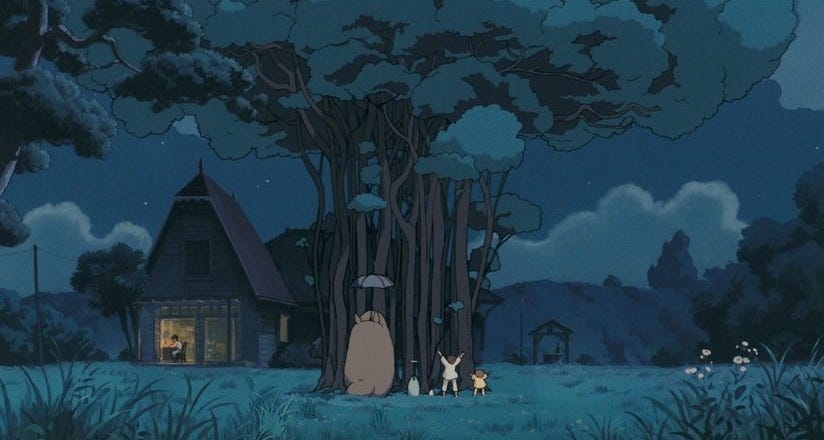
Miyazaki draws rain the way a botanist catalogs species. In My Neighbor Totoro, the drops arrive at different speeds onto different surfaces: pooling in the grooves of an umbrella, pocking the surface of a puddle, running down the fur of a creature eight feet tall who has never seen an umbrella before and is mesmerized by the sound it makes. His forests are not backdrops; they are ecosystems rendered with the patience of someone who has watched one tree through many seasons. The food in his films is famous: an egg cracking into a pan with the precision of a Dutch still life, steam curling off ramen in spirals that suggest the animators studied fluid dynamics just to get three seconds right. Every frame insists that the world is worth the time it takes to observe it closely. I love Ghibli films for this reason.
Earlier in my fellowship, at my lowest point in Amsterdam following a breakup, an independent theater was running a month-long marathon of every Ghibli film. I went about every other day. It became a place to feel things. To watch characters navigate loss and confusion and come out different on the other side. I became a bit of a fanatic.
So when I heard there was a park, a physical manifestation of the films, I had to go. A place built to bring strangers into the worlds of an animator who had spent forty years imagining them felt, by the generous logic of a fellowship exploring social technologies, like work.
Before I went, I had read Sam Anderson’s New York Times Magazine piece about Ghibli Park, “Spirited Away to Miyazaki Land.” It’s a beautiful essay. Anderson describes the park as a quiet rebuke to American theme parks, a place where the trees and the silence are themselves the attraction, where you pause to watch a spider weave its web in the upper branches and that counts as the experience. I read it twice. I built up an image of Ghibli Park as a pilgrimage site, a place where the studio’s reverence for slowness had been protected by a commercial structure that knew not to interfere.
Some of that turned out to be true. Some of it I had projected onto the article.
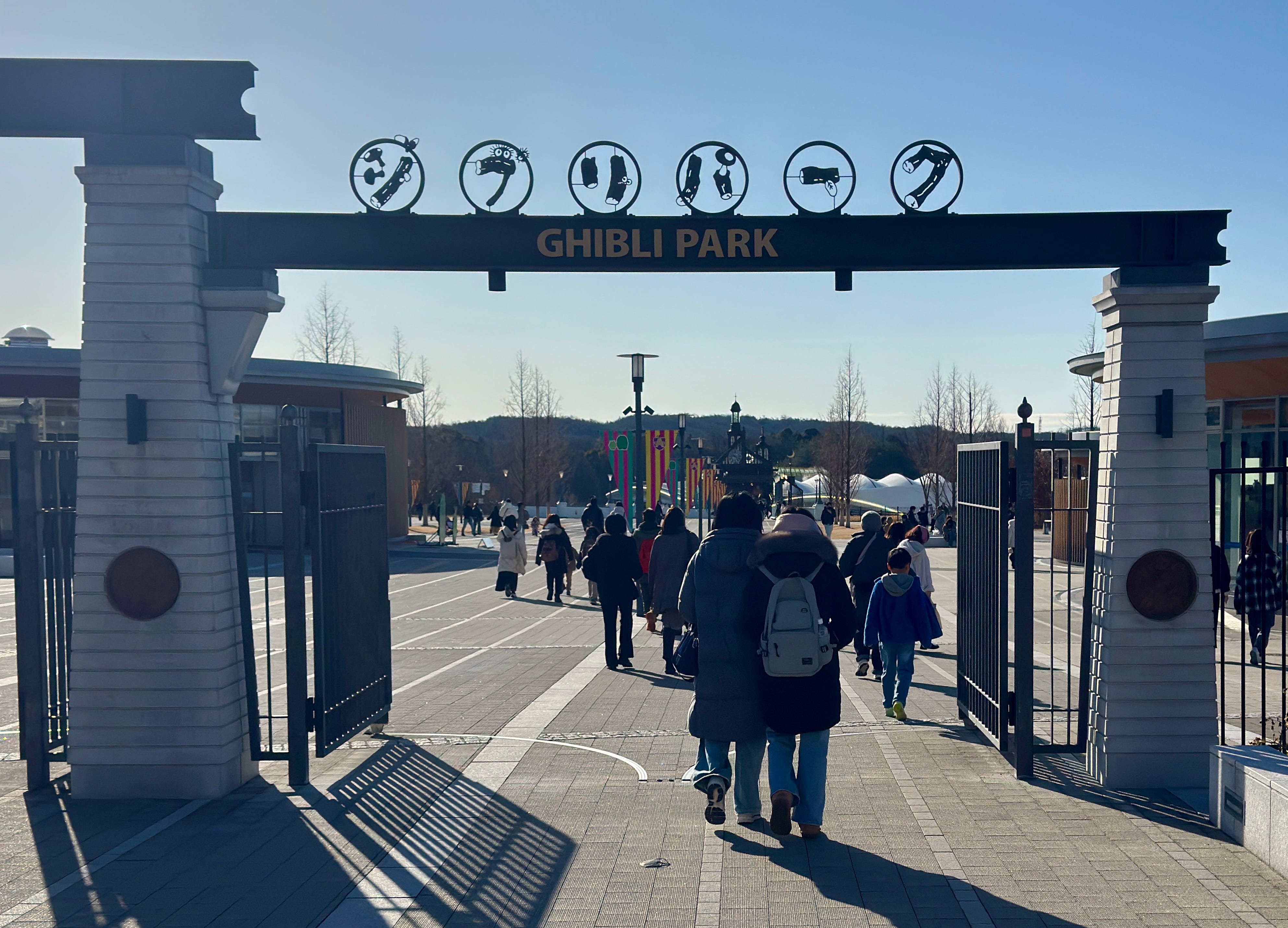
I’d been inside the warehouse, arguably the most famous part of the park, for maybe twenty minutes. On entry, I’d accidentally shown the staff my bus ticket instead of the QR code I’d reserved a month in advance. Someone who spoke English had to come help me. Already charmed and flustered and I hadn’t really seen anything yet.
The warehouse was weirdly silent. No music. No voiceover. Just footsteps on polished floors, the soft sound of Japanese camera shutters at the designated photo ops, and the crow-foot eyes of smiling families recognizing characters or things they love.
A father kneeling next to his daughter in front of a life-sized Ponyo.
A band of boys jumping up and down inside a furry cat bus.
A perplexed person with their head craned upward at a replica wooden ship flying through the sky of the warehouse.
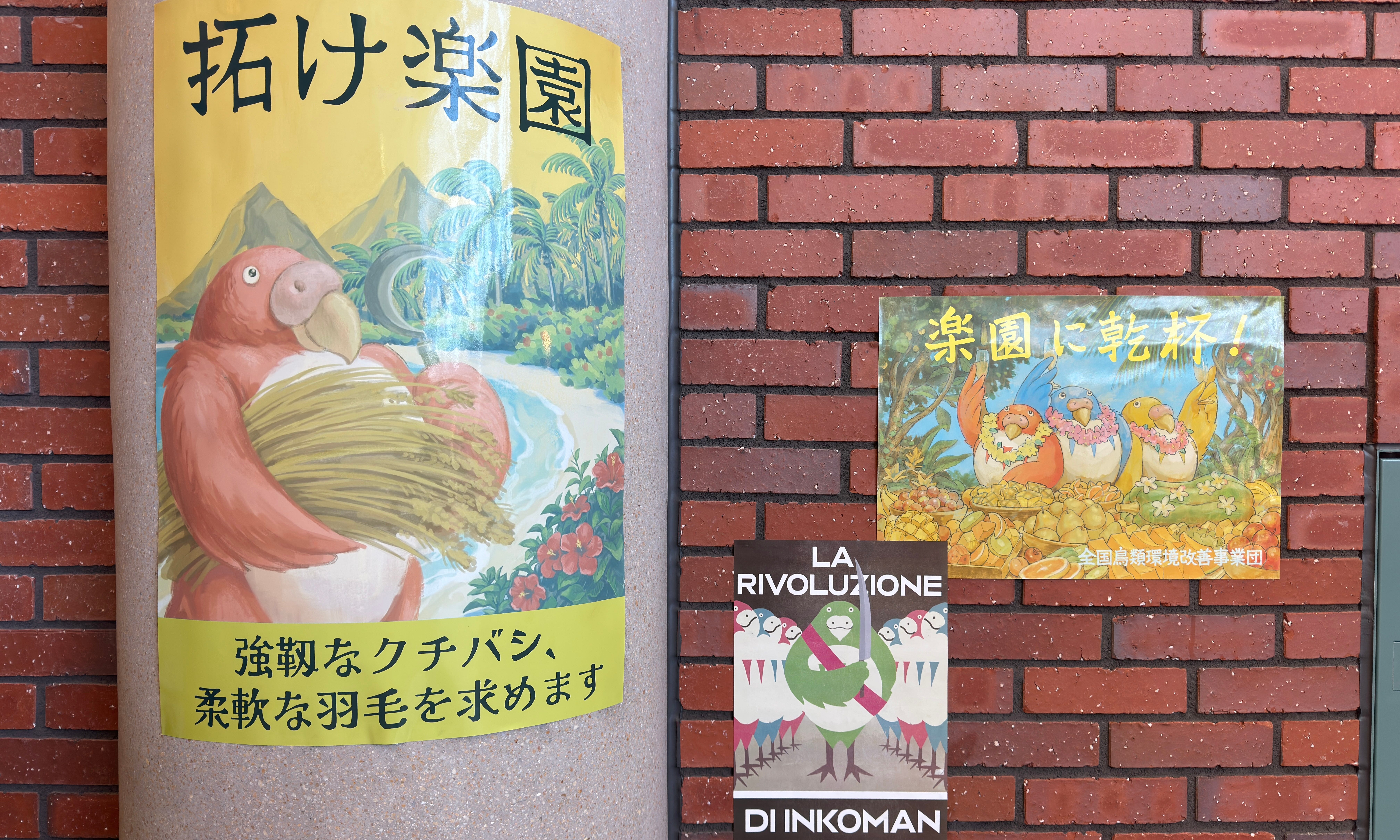
I stood eye-level with a giant animatronic parakeet from Mr. Dough and the Egg Princess behind jail bars, its foot pumping a pedal for some kind of machine. Vibrant green felt body, messy apron tied around its back, bones and food scraps at its feet. The jail cell was tucked into a discrete corner. I stood and watched how nearly everyone walked past without noticing it. This enormous, bizarre, pedaling bird, invisible to anyone not looking carefully.
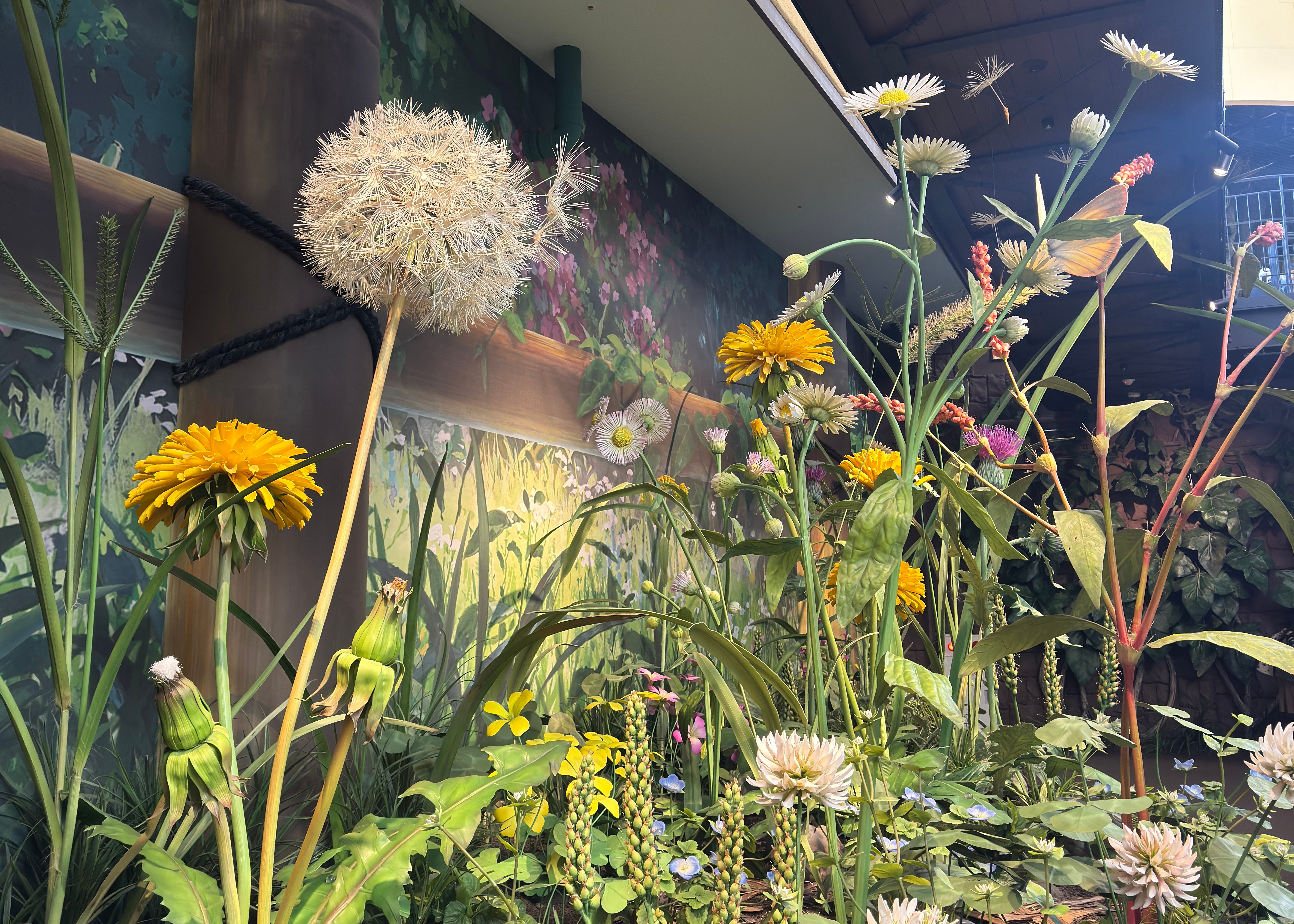
I entered another room: an elevated pathway through a warehouse inside the warehouse, half-unpacked things on display for people to find on their own terms. It was like an I Spy book encouraging a quality of noticing rather than consuming. A plane hung from the ceiling from The Wind Rises, with the swept wings Miyazaki animated with the obsessive precision of the engineer the film is about. Below it, an old car sat on the floor that looked like it belonged in some European Ghibli countryside, though I couldn’t place which film. Pallets and crates of these kinds of things were stacked throughout.
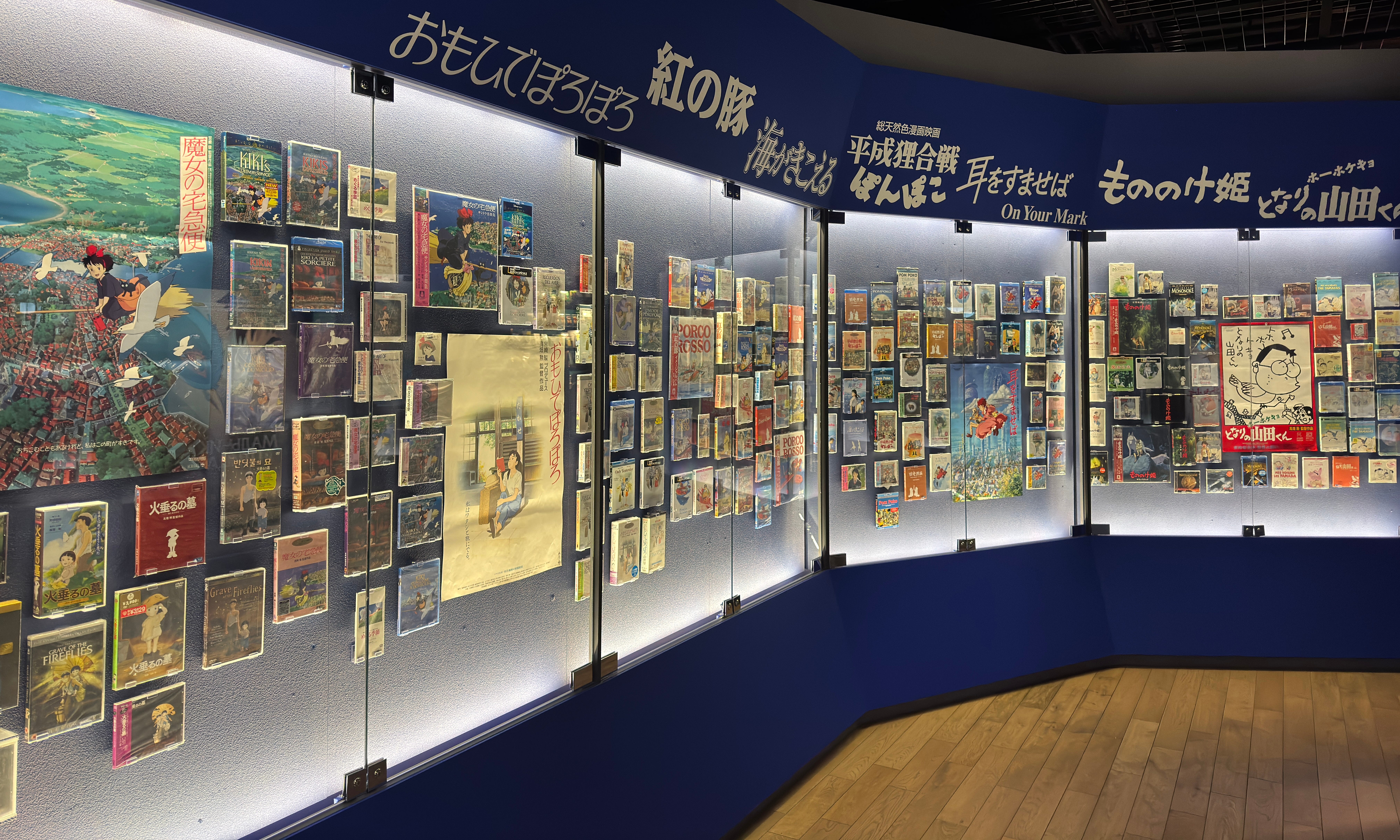
Next I walked through a doorway I wasn’t sure was an entrance or an exit and was led into a hall of food. Raw sketch sheets showing the details Ghibli animators obsess over: the tiny bubbles forming in a pan when bacon starts cooking, the way water tilts in a glass as someone drinks. One sketch showed a character looking down, deflated, then biting into a sandwich, their entire expression shifting. So much of a Ghibli film lives in the eyes. To me the food exhibit wasn’t really about food; it was about the moment the food creates.
As the afternoon went on I noticed something: workers entering or exiting through what I assumed was a staff door would bow toward the warehouse before crossing. Watching them, I found myself moving more slowly, speaking more quietly, looking more carefully.
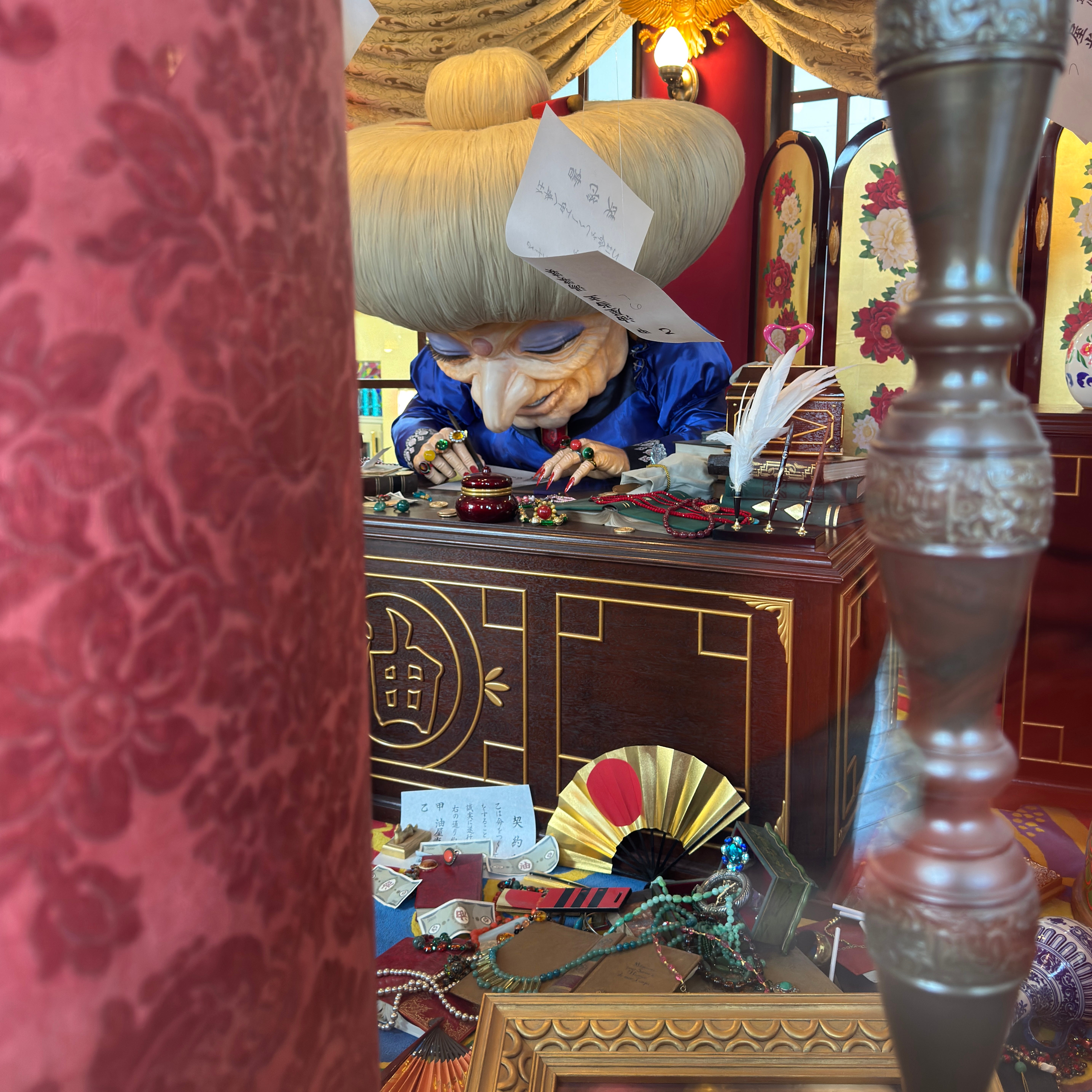
Outside the warehouse, the park’s other worlds were more uneven. Valley of the Witches, the most recently opened, felt closer to a traditional theme park, with Joe Hisaishi’s scores playing as a merry-go-round spun kids around.
I climbed a set of random stairs on the side of a Bavarian looking building and was led into a replica living area. A bed, kitchen items, cutlery, a cereal box. It felt like getting to walk beyond the rope at a museum exhibit. I pulled out my phone to take a picture and was immediately stopped by a staff member. No photos in this section.
I walked down the stairs feeling like I had just been caught shoplifting a vibe. I had been in the room for ten seconds. I had seen a cereal box. I did not know what brand it was. I did not know what it said. I only knew I needed to document the cereal box. Why? For whom? The cereal box was not asking to be documented. The cereal box was doing fine.
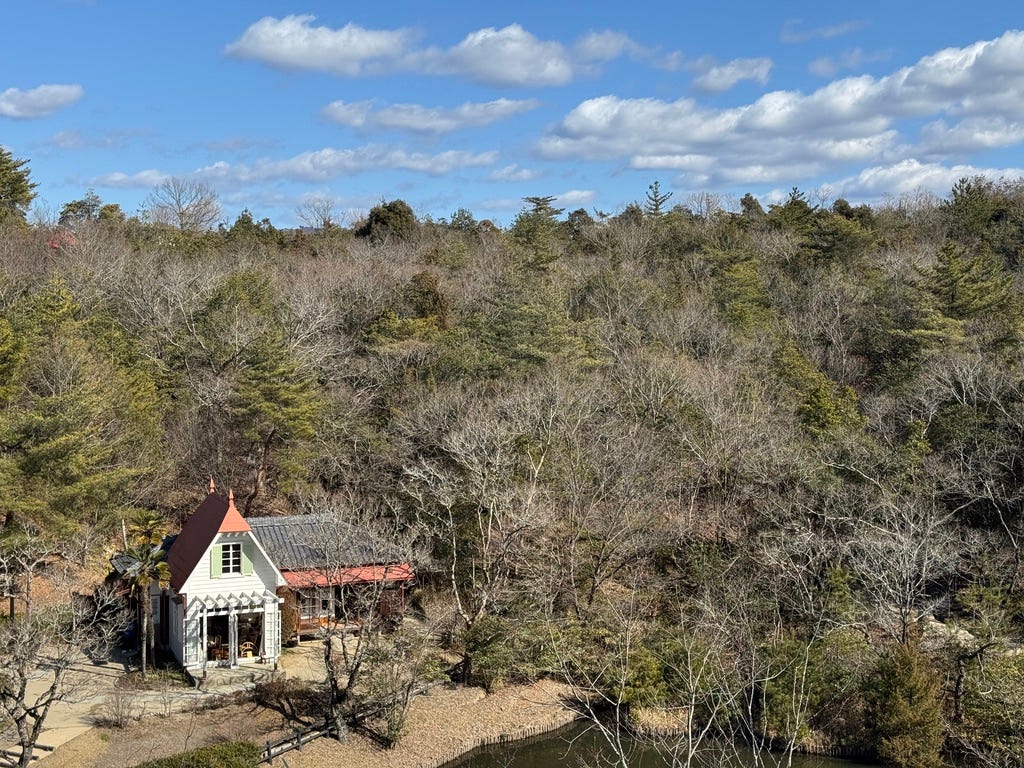
I’d read that at Satsuki and Mei’s house from My Neighbor Totoro, there’s a replica of the hole where the sisters can see Totoro in the film, but in the park the hole is empty. I wanted to see this for myself. I walked twenty minutes across the park to get there. When I arrived and showed my QR code, they told me I didn’t have the right ticket. There was a premium tier required for access. I walked up a cement structure across the valley from the house and looked down on it from a distance, the magic of the morning starting to thin. Tiered pricing. It felt more like Disney than I had initially thought.
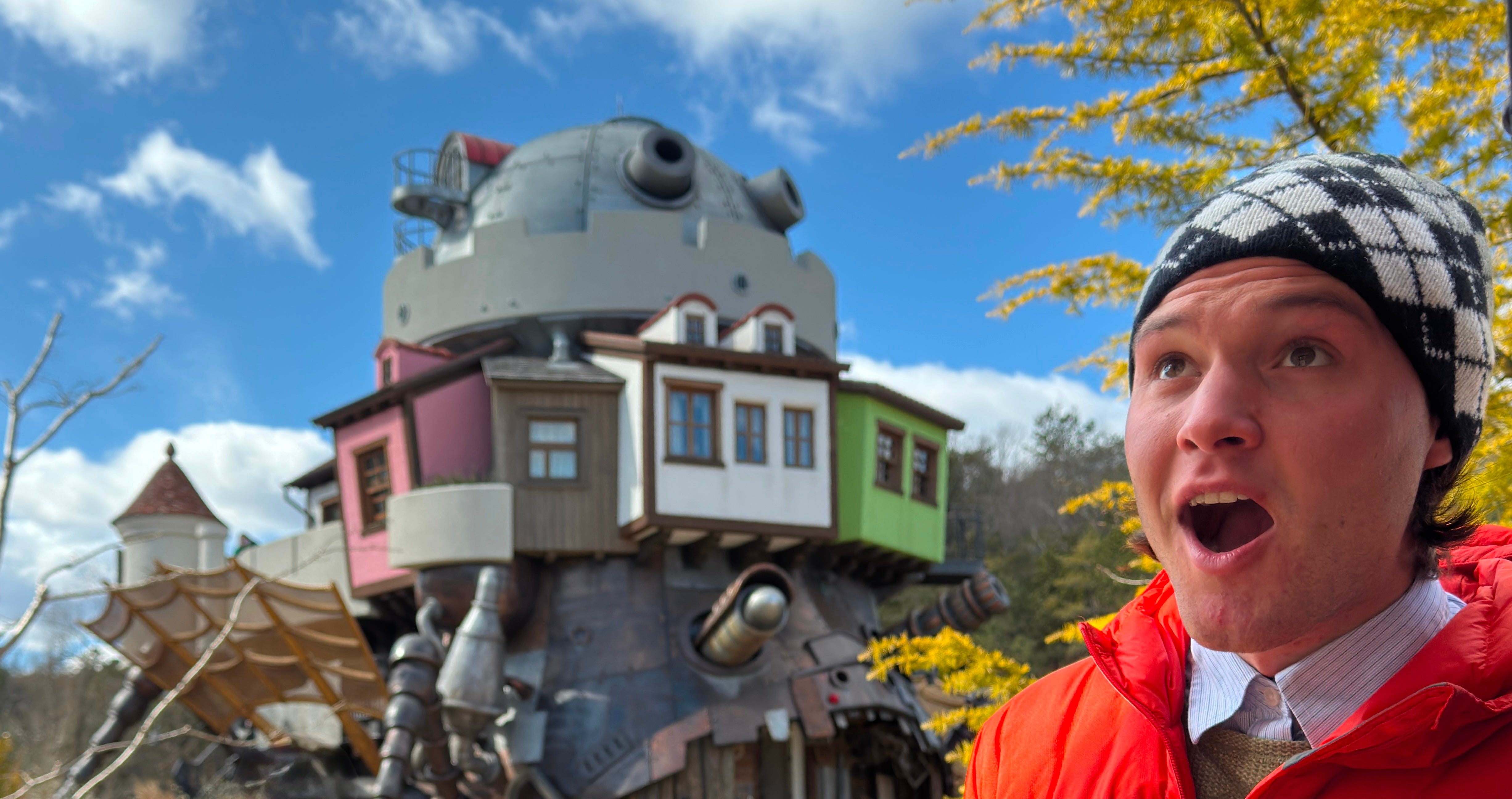
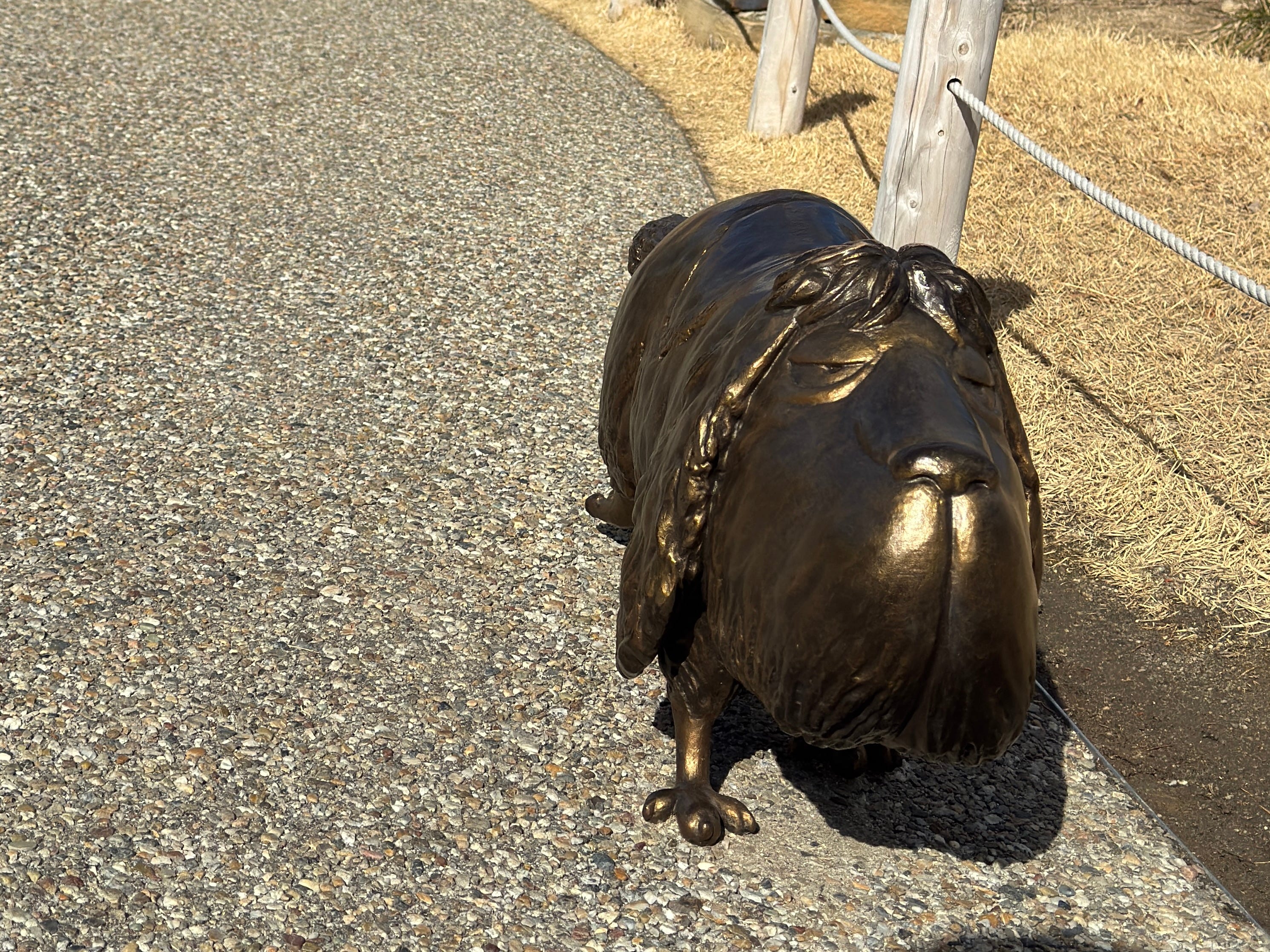
After about five hours of roaming the worlds I did have access to, I noticed almost every other person had a handbag stuffed with a plush version of Heen, the wheezy old dog from Howl’s Moving Castle. Once you see one Heen you start seeing all the Heens. It was actually insane how many people had bought one of these dogs. I almost had FOMO that I didn’t get one. I have never owned a plush toy in my adult life. I do not need a Heen. I began to think maybe I needed a Heen.
I did not get a Heen.
I bought a magnet of the frying pan from Howl’s Moving Castle for my mom. Anywhere I travel, I bring her back a magnet for her fridge.
I’ve been reading Solvej Balle’s On the Calculation of Volume recently, a novel about a person trapped in a single repeating day who discovers that the more she lives it, the more it holds. The same hours contain more the hundredth time than the first. Not because anything changes but because her attention deepens until a single day has the depth of a year.
The title keeps rattling around in my head because I think what I’ve been exploring all year on this fellowship is something similar: the volume of social spaces. How much a space can hold. Not its content but its capacity for experience, the room it leaves for silence and accident.
I feel like Ghibli films understand this. There are scenes in Miyazaki’s work where nothing happens. Seconds pass that seem to serve no narrative purpose. In My Neighbor Totoro, Satsuki stands beside Totoro in the rain for what feels like a full minute before anything occurs, and the film is not building to a reveal. It is holding open a stretch of time so the viewer can exist inside the same moment the character does. Most animation compresses time. Miyazaki lets it pool. And that pooling is where the feeling lives, the same way I feel like meaning in Balle’s novel accumulates not in the events of November 18th but in the strange depth that builds as the same day repeats and begins to hold more than a single day should be able to contain.
Every social space has this quality to some degree. A cafe has it: the space has depth and smell and a barista who recognizes you. There’s room for things to happen that nobody planned like overhearing a conversation or watching rain through a window. The space has volume. The more you show up to it, the more it holds.
Ray Oldenburg called the spaces between home and work “third places.” The cafe, the library, the park bench, the pub. Places where community forms without agenda, where you show up and see who’s around and something emerges from the gathering.
In the last several decades digital social technologies have increasingly become third places for the masses. For many people I know, the group chat or Discord is the pub. The feed is the town square, or what’s left of it.
The volume thins in the migration of physical to digital. Not because digital spaces can’t hold depth. A long email thread between friends has volume. A small forum where people know each other has volume. But I believe the dominant social platforms of today compress it. The feed moves at the platform’s speed, not yours. You don’t walk between rooms. You’re teleported. And whoever built the teleporter decides what you see when you arrive. The compression isn’t a property of digital space itself. It’s a choice, made for economic reasons that have only become more intense as the years have worn.
Ghibli Park is commercial. I bought my ticket more than a month in advance and it was the last slot available for the day I wanted. The park caps daily attendance at around five thousand people, and from what I can tell it sells out almost every day, even though its location is not exactly on the way to anywhere.
Disney Parks, by contrast, also sell tickets and also have gift shops and also have your money the moment you walk through the gate. They also cap attendance (although with much more tolerance for crowding). By that logic Disneyland should feel as expansive as Ghibli Park. It doesn’t.
The difference is in who owns the space and what kind of return they need from it. Disney is a publicly traded entertainment conglomerate that reports to shareholders quarterly, with growth targets and per-capita guest spending metrics. The ticket is the entry point to a much larger funnel. The bounded transaction isn’t actually bounded.
Ghibli Park is operated by a joint venture between Studio Ghibli and Chunichi Shimbun, the regional newspaper, on land owned by Aichi Prefecture. The prefecture has commercial interests too. The park is projected to generate something like forty-eight billion yen a year in regional economic impact, and that number matters to the people who approved the budget. But it’s a different kind of commercial interest than Disney’s. The prefecture measures success in tourism, cultural prestige, and the long-term reputation of the region. Studio Ghibli measures success, at least partly, in feeling like Ghibli and not Disney.
One park is not a theory, though. Ghibli Park is unusual in ways that make it hard to generalize from. Miyazaki is a singular cultural figure. The studio has the kind of soft power that lets it negotiate with a prefecture as a near-equal. Most spaces do not get to be built this way. So I'm not claiming the exact Ghibli model, a joint venture between a studio and a regional newspaper on prefecture land, is a blueprint anyone can copy. I'm claiming it's evidence that when the people upstream of a space are not forcing the money to grow at a particular rate, the space can hold more. Public libraries are evidence of the same thing from a different angle. So are community radio stations, small forums run by one person, the email list Nikolai sends out from Kamiyama. The examples are scattered and none of them scale the way venture-backed platforms scale.
The mechanisms differ depending on the space. Disney compresses attention through choreographed spectacle engineered to move guests efficiently toward the next per-capita-spending opportunity. The compression is physical and logistical. Venture-backed digital platforms compress it differently, through the feed that never ends, the autoplay that eliminates the pause, the notification that interrupts the moment your attention starts to settle. The compression is algorithmic and continuous. Different mechanisms, same underlying pressure: shareholders who expect compounding returns, returns that require engagement, engagement that requires eliminating every exit ramp, every moment of silence that might let someone put the phone down and watch a spider weave its web.
A public library doesn’t do this. A park bench doesn’t do this. Ghibli Park, mostly, doesn't do this. Not because they’re free of money. Libraries have budgets and benches sit on land that costs something to maintain. They don’t compress because nobody upstream is forcing the money to grow at a particular rate. The capital structure of a space determines its rhythms the way a riverbed determines the current.
There's no single model for this. But in the second half of my fellowship I've been noticing the shape of alternatives: impact-first funds that accept slower returns, crowdfunded seed rounds for tools nobody would venture-back, public infrastructure that gets built once and maintained cheaply, and public-private partnerships like the one that enables Ghibli Park. None of these are new exactly. What feels new is that they're starting to add up to something — a quiet set of riverbeds for social technologies that don't have to grow the way the last generation did.
So, the change from digital to physical for Ghibli. What survived the crossing?
Totoro didn’t. The dream logic, the motion, the way characters float and fall in ways that defy physics. Goro Miyazaki, who directed the park’s development, understood this. He’s been quoted saying they wanted to do something authentic, that once you try to bring Totoro into reality, you can only do it with a doll or a robot, and it loses authenticity. Hence the empty Totoro hole at Satsuki and Mei’s house. Better to build the feeling that he might be there. Those things belonged to the previous state. They were properties of light on a screen, the way fluidity is a property of liquid water. Trying to force them into the new format produces something fake.
What survived, though, was the quality of attention.
The films have always been about a particular way of attending to the world. Noticing small things. Sitting with discomfort. Letting meaning accumulate rather than announcing it. And the park preserved that. The silence preserved it. The absence of a suggested path preserved it. The I Spy quality of searching without labels preserved it. The parakeet behind bars that almost nobody saw preserved it.
Most mainstream social platforms are engineered to eliminate silence. The moment you finish one video, another starts. The moment your feed goes quiet, a notification pulls you back. But Ghibli Park seems to be designed around the premise that some things should remain empty. That the emptiness is the design. That the volume of a space can be measured not by how much it contains but by how much room it leaves.
So the question is: what capital structures enable the kinds of spaces we actually want to inhabit? Maybe the spaces that invite the richest attention are structurally incompatible with the capital structures that dominate technology. Maybe these things only work at small scales, and small scale is the point. I don’t fully know. But I think we need to be talking about capital structures as much as we talk about design, because capital structures shape design, eventually, more than designers do. I wish this weren’t true. I wish my general ticket had let me into Satsuki and Mei’s house.
I walked out through the expo park back toward the train station I had arrived through. A high school taiko drumming competition was happening on a stage near to the warehouse. I stopped and watched. Three drummers in white headbands were trading patterns, the big drum at the center pulling everything around it into rhythm. I could feel it in my chest before I could hear it properly. I stood there until the final group finished.
Then I kept walking. I bought nuggets from the Lawson convenience store on the way. They were good. The clouds above the hill looked like they were from a Ghibli film. Puffy and absurd and slow-moving, like someone had painted them there.
I sat on a bench eating my nuggets watching others head for the train. I felt two things at once: ready to leave, and like I could spend three more hours in each world. Neither feeling winning. Just both, holding each other in place.
The boy in the film, Nona, tended a planet for a few days and then had to let it go. He stood and watched it float away into a current of other worlds and he did not try to follow. The thing he tended was small and the time he spent on it was, by the standards of the city he had escaped, wasted. But the tending was what made the planet a planet. Without him it would have simply remained a seed. The wasted time was required.
That’s what Ghibli Park is, I think. A place that lets you waste your attention on small things. The parakeet behind the bars. The empty hole where Totoro might be. The five minutes of trees between one world and the next. None of it advances anything. None of it has to. The volume of the experience is the room it leaves for time you cannot account for.
Much love from Lucknow,
Dan